
 Alex
AlexCNC turning is a subtractive manufacturing process in which a cutting tool moves linearly while the workpiece rotates at high speed. The process is executed on a CNC lathe, where the rotating workpiece is called the stock, and the stationary cutting tool removes material to create the desired cylindrical geometry. This fundamental difference from CNC milling where the tool rotates and the workpiece is stationary defines the applications best suited to each process.
The core components of a CNC lathe include the headstock which holds and rotates the workpiece, the tailstock which supports the opposite end of long parts, the tool turret which indexes between cutting tools, and the CNC controller which executes the programmed tool paths. Modern CNC lathes can perform turning, facing, grooving, threading, drilling, and boring operations in a single setup, dramatically reducing handling time compared to manual lathes.
CNC turning is the most efficient process for producing axisymmetric parts: shafts, bushings, pulleys, fittings, and any component where the critical features are concentric with the center axis. The process achieves typical tolerances of ±0.025 mm with standard tooling and can reach ±0.005 mm with careful setup and finishing passes. Surface finishes of Ra 0.8 μm are routinely achievable, with Ra 0.2 μm possible using wiper geometry inserts and optimized feeds.
- External turning reduces the diameter of the workpiece along its length, creating stepped shafts, tapers, and contours.
- Facing cuts across the end of the workpiece to create a flat reference surface perpendicular to the axis of rotation.
- Boring enlarges existing holes using a single-point boring bar, achieving better concentricity and surface finish than drilling.
- Threading cuts internal or external threads using a specially shaped tool that moves in synchronization with the spindle rotation.
- Grooving and cutoff create narrow channels on the part surface or separate finished parts from the bar stock.
Partnering with a provider that offers precision machining services that include CNC turning ensures your round parts are produced with the accuracy and surface finish required for proper fit and function. The ideal turning partner maintains a range of machine sizes, from small Swiss-type lathes for medical screws to large horizontal lathes for oilfield components, and has the tooling inventory to handle materials from free-machining brass to heat-treated tool steels.
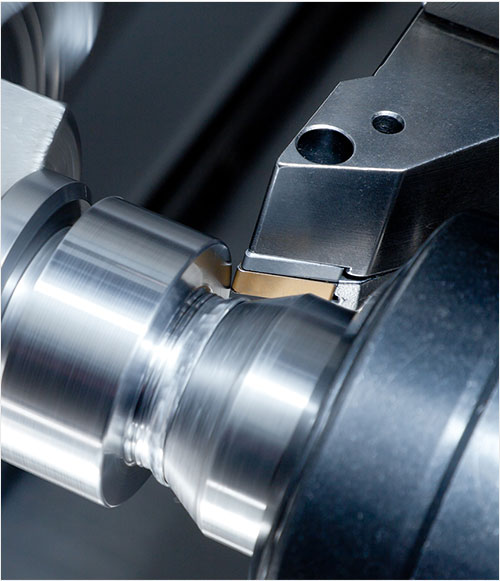
For parts requiring secondary operations after turning such as cross-drilling, slotting, or off-center features live tooling CNC lathes with powered tooling stations can complete the part in a single setup. This eliminates the need for a second operation on a milling machine, reducing handling, setup time, and the cumulative tolerance stack from multiple fixturing steps. A partner that offers prototype machining with live tooling capability is particularly valuable for complex parts where concentricity between turned and milled features must be maintained.
